
The structural layer built directly upon bone—and the real reason the lower face descends with age.
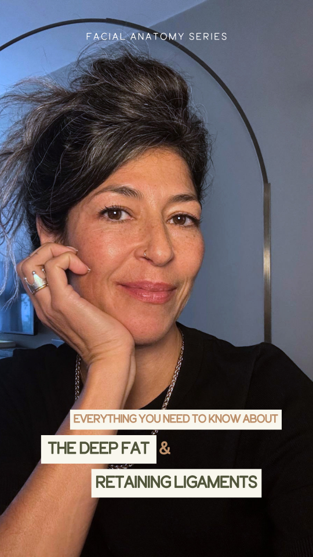
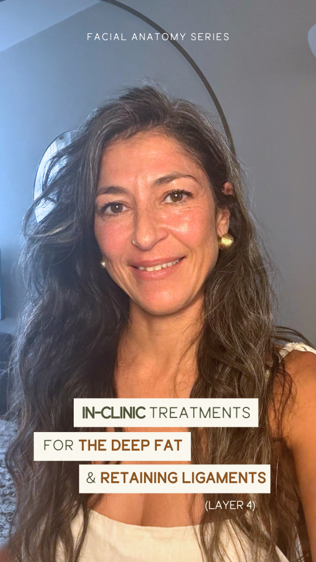
Last month, we explored Layer 5—the foundational facial skeleton. Everything rests on that bone matrix. Directly above that skeleton sits Layer 4: the deep fat and deep SMAS (Superficial Musculoaponeurotic System). This layer acts as the physical scaffolding of your midface and jawline. When this layer fails, structural tissue shifts downward, resulting in severe sagging, heavy jowls, and deep facial fat loss.

KEY TAKEAWAYS
- The True Scaffold: Layer 4 is the most structurally important soft tissue layer in the face, sitting directly above the bone.
- Anatomical Makeup: It comprises deep fat compartments (volume reservoirs) and deep SMAS muscle fibers that connect directly to the skeleton.
- The Suspension System: Retaining ligaments anchor this layer to the bone, transmitting lifting forces upward through every layer of the face.
- The Aging Effect: When this layer weakens, jowling, midface descent, and deepened folds follow.
- Clinic-Based Necessity: No at-home treatment can reach this depth; true structural correction requires clinic-based intervention.
- Targeted Goals: Treatments at Layer 4 restore soft tissue volume, which is distinctly different from Layer 5 treatments that augment bone.
Understanding Facial Aging: What Controls Deep Structural Sagging?
To truly understand how the face descends with age, we have to look past the surface skin. As mentioned in our guide to bony foundation restoration and facial skeleton aging, everything relies on a strong foundation. When Layer 4 fails to hold its ground, the entire soft tissue envelope collapses downward. Treating only the surface layers produces incomplete results because it ignores the structural scaffolding sagging underneath.
The Anatomy: What is the SMAS Layer and Deep Facial Fat?
Layer 4 sits directly above the bone and periosteum of Layer 5. It features two inseparable, structural components:
- Deep Fat Compartments: These behave as dense volume reservoirs, cushioning the face from within to maintain youthful contours.
- Deep SMAS Muscle Fibers: Structurally firmer than the superficial SMAS, these are architectural muscles. They are not designed for facial expressions; their sole job is to shape, support, and anchor the structural framework of your face.
The key anchors are the deep portions of the zygomaticus major and minor (responsible for cheek and midface lift), the levator labii superioris (upper lip support), the levator anguli oris (corner of mouth elevation), and the deep fibers of the platysma (jawline definition).
Anchoring all of this to the underlying bone are the zygomatic, mandibular, and masseteric retaining ligaments. Think of these as the suspension cables of the face. They attach the muscular SMAS mass directly to the skeleton, transmitting lifting forces upward through every layer above it.
What Causes Sagging Jowls and Midface Descent?
As we age, Layer 4 undergoes three distinct structural failures that heavily alter our appearance:
- Deep Fat Deflation: The deep fat compartments lose volume and shrink, collapsing the midface scaffold from the inside out.
- Muscular Atrophy: The deep structural muscles thin out, losing their baseline architectural support.
- Ligament Laxity: The retaining ligaments stretch away from their fixed bony anchors.
When these suspension cables stretch and weaken, everything above them—fat, muscle, and skin—descents with them. This produces heavy sagging jowls, a weighed-down lower face, deep nasolabial folds, and profound temple hollowing. True structural correction requires reaching a 4 to 6 mm depth or beyond to address this root issue
Layer 4 vs. Layer 5: Deep Facial Fat Loss vs. Bone Resorption
Treatments at these deep planes serve entirely distinct clinical purposes, even when utilizing identical dermal fillers:
LAYER 5 — Bone Level (Skeletal Augmentation)
Injections are placed directly on the bone (supraperiosteal plane) to abut an immovable structure.
Goal: Augment bony prominences—restoring the projection of the cheekbone, orbital rim, or jaw—to provide lift to all overlying soft tissue layers.LAYER 4 — Deep Fat & SMAS(Soft Tissue Volume)
Injections are placed within the deep fat plane to correct localized fat atrophy and compartment deflation.
Goal: Restore the soft structural volume lost within the tissue scaffold itself, rather than reinforcing the bone beneath.How They Connect: The Impact of Bone Loss
As the facial skeleton resorbs (Layer 5), the bony anchor points for Layer 4’s retaining ligaments retreat inward. The ligaments lose their fixed foundation, accelerating the descent of everything above. The most complete rejuvenation addresses both layers together: restoring bony projection at Layer 5 while correcting volume loss and SMAS laxity at Layer 4
How to Tighten the SMAS Layer: In-Clinic Treatments vs. Home Care
Why At-Home Devices Cannot Tighten the SMAS Layer
No at-home skincare treatment, gua sha tool, microcurrent device, facial roller, or facial exercise can reach Layer 4. The deep fat compartments and SMAS layer reside at depths of 4.5 mm to 6 mm. Topical ingredients and home devices operate entirely within the upper surface layers of the skin. While nutrition, vitamins C and D, and facial movement support baseline skin vitality, structural correction demands professional medical intervention.
The Advanced Clinical Treatment Blueprint
| Effect | Onset | Duration | Safe | Dr Miriam A | |
|---|---|---|---|---|---|
| HA Filler | Restores volume directly in deep fat compartments, correcting fat atrophy. A small volume placed correctly achieves significant lift across multiple zones. | Immediate | 12–18 months, often longer at depth | Yes — dissolved with hyaluronidase if needed | "My definitive first-line choice for deep facial fat loss. It offers immediate, highly predictable, and completely reversible correction." |
| CAHA — Radiesse | Immediate volume in the deep fat plane plus collagen and elastin stimulation via controlled inflammation over time. | Immediate volume; collagen builds over months | 12–18 months+; collagen persists longe | Mainly safe. Not reversible — biodegrades slowly | "An excellent intervention when a patient requires both immediate structural volume restoration and long-term collagen production at depth. Note: non-reversible." |
| PLLA — Sculptra | Biostimulator only — no immediate volume. Stimulates collagen at the deep fat plane via controlled inflammation. | Delayed — results appear over months | 18–24 months | Some risk of nodules. Slow resolution or may require surgical removal | "Highly effective, but results depend heavily on individual biological response. It demands careful patient discussion due to delayed results and a minor risk of deep nodules." |
| HIFU | High-intensity focused ultrasound deposits thermal energy precisely at 4.5 mm, targeting the SMAS directly. Induces collagen remodelling and tissue contraction at true Layer 4 depth. | Initial tightening immediate; full result at 3–6 months | 12–18 months; often a single treatment suffices | Yes | "The single best non-surgical treatment to tighten the SMAS layer. It is the only non-invasive modality with consistent, calibrated anatomical precision at true Layer 4 depth." |
| RF microneedling |
Insulated needles deliver RF energy to 3–8 mm, reaching the superficial SMAS and upper Layer 4. Generates subdermal remodelling and some tissue contraction.
Three treatments recommended for best results. |
Gradual over 3–6 months | 12–18 months per course |
Unclear — practitioner dependent. Complications include burns, scarring, permanent fat loss, and nerve damage.
⚠ FDA warning issued |
“Not recommended. Recent FDA warnings highlight serious complications, including burns, permanent scarring, fat loss, and nerve injuries. Results are often underwhelming relative to the cost and discomfort.” |
| Deep-plane surgery | Surgically repositions and tightens the SMAS and retaining ligaments. The only treatment that directly corrects ligament laxity — re-anchoring the scaffolding rather than adding volume above it. | Immediate, with post-surgical recovery | 7–12+ years | Yes — in experienced hands; surgical recovery required | "The gold standard for significant structural tissue descent. Surgery directly repairs ligament laxity where non-surgical modalities fall short. A thorough consultation is essential." |
Can you tighten the SMAS layer at home without surgery?
No, it is impossible to tighten the SMAS layer using at-home treatments. The deep SMAS muscle fibers and facial retaining ligaments sit at an anatomical depth of 4.5 mm to 6 mm. Professional devices like clinical-grade HIFU or deep-plane surgical intervention are the only methods capable of reaching and remodeling this deep structural scaffolding. If you present skin-level laxity rather than deep structural sagging, read our clinical breakdown of medical-grade topical skincare and skin barrier repair instead.
What is the difference between deep facial fat fillers and bone-level injections?
The core difference is the treatment objective. Structural filler placed at Layer 5 (directly on the bone) augments skeletal frame projection, using a hard foundation to lift everything above it. Filler placed at Layer 4 targets deep fat compartments specifically to correct fat atrophy, replacing lost soft tissue volume to re-inflate a hollowed midface.
Is HIFU safe for non-surgical SMAS tightening?
Yes, medical-grade HIFU (such as Ultraformer) is a highly safe, clinically proven modality for non-surgical SMAS layer tightening when administered by trained medical specialists. Utilizing a precise 4.5 mm transducer, it deposits focused thermal energy directly into the structural scaffolding without disrupting the skin surface or causing structural fat atrophy. A single treatment is typically sufficient to last 12–18 months.
Why did the FDA issue safety warnings for RF microneedling?
The FDA issued warnings following an increase in severe medical complications from radiofrequency (RF) microneedling devices. When energy settings or depth parameters are mismanaged, the treatment can cause permanent subdermal scarring, severe facial fat loss, thermal burns, and motor nerve damage. Because these risks are highly practitioner-dependent and can cause irreversible hollows, Dr. Miriam A no longer offers this treatment.
Read Dr. Miriam’s latest blogs


Join Dr. Miriam’s Newsletter
Join our mailing list to receive Dr. Miriam’s seasonal skin care tips, her latest discoveries and special offers
You can unsubscribe at any time by clicking the link in the footer of our emails. For information about our privacy practices, please visit our website.